Erich's Phase Model©
Understanding the phases of development
Life rarely unfolds in a straight line.
Whether in personal development, leadership, sport, or organizational life, people experience periods of stability, uncertainty, disruption, reflection, and renewed growth. These movements are not random. They often follow recognizable patterns that shape how we experience change and how we respond to it.
Erich's Phase Model© offers a practical framework for understanding these movements. It helps individuals, leaders, athletes, and teams recognize the phase they are currently experiencing and navigate it with greater clarity and resilience.
Because when we understand the phase we are in, uncertainty often becomes easier to manage.
Have a look at the two blogs describing the model:
Erich's Phase Model© - The Theory Behind
https://evolving.zone/blog/life-coaching/erichs-phase-model-the-theory-behind/
Erich's Phase Model© and the High-Performing Athlete:
https://evolving.zone/blog/life-coaching/erichs-phase-model-and-the-high-performing-athlete/
Not a general life-cycle model
The Phase Model does not rely on broadly known life-cycle theories or predefined age-based life phases.
It is not built on the assumption that all people move through identical developmental stages at the same moment in life.
Instead, the model starts from the individuality of each person and from the observation that development is shaped by personal experience, context, perception, relationships, and decision-making.
Two people may experience similar events while moving through entirely different internal phases.
This perspective is strongly influenced by the principles of Alfred Adler's Individual Psychology, which views each person as unique, embedded in social systems, and constantly interpreting life through individual meaning.
The model therefore does not ask:
“What age should this phase belong to?”
but rather:
“What is unfolding in this person's developmental reality right now?”
Life unfolds in phases
A central idea behind the Phase Model is simple but powerful: life unfolds in phases.
These phases are dynamic and influenced by emotions, experiences, and the environments in which we operate.
They are not strictly linear, and they are rarely synchronized across all areas of life.
At any given moment, different aspects of our lives may be evolving in different directions. One area may be thriving while another feels uncertain or challenging.
Understanding this dynamic helps people avoid interpreting temporary difficulty as permanent failure.
Instead, challenges can be seen as part of a broader developmental process.
The emotional architecture of development
One of the key insights behind the Phase Model is that development is deeply connected to emotional dynamics.
Every significant experience — success, failure, injury, transition, conflict, achievement, loss, recognition, or uncertainty — creates emotional responses that influence motivation, perception, and behaviour.
In demanding environments such as leadership, personal transition, or sport, these emotional fluctuations often become particularly visible.
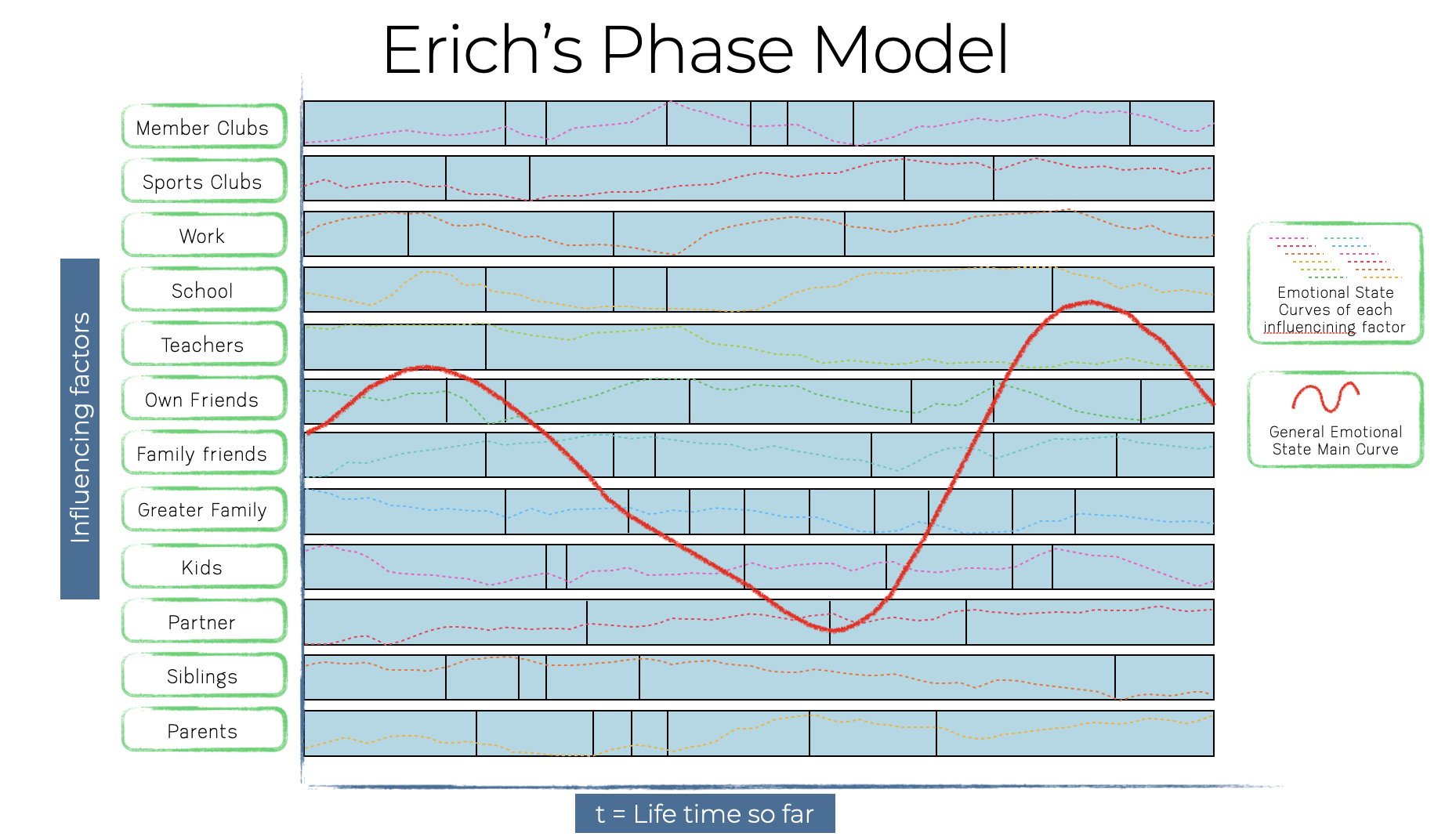
The Phase Model therefore looks not only at the influencing factors and the events themselves, but at the emotional curves that accompany them.
Different influencing factors — relationships, expectations, external pressure, identity questions, support systems, health, and environment — each follow their own emotional trajectory.
These trajectories rarely move in the same direction at the same time.
The overall experience of a phase emerges from the interaction of these different influences.
The influence of systems and environments
Human development never happens in isolation.
Our experiences are shaped by the systems around us, which Erich calls influencing factors:
- family
- friends
- colleagues
- teams
- organizations
- culture
- social expectations
Erich's Phase Model© recognizes that development emerges from the interaction between the individual and these surrounding influencing factors.
For example, an athlete's performance may be influenced simultaneously by:
- relationships with coaches and teammates
- expectations from parents or supporters
- school or academic pressure
- injury and recovery
- competition schedules
- identity development
The same principle applies in leadership and organizational life.
A professional challenge is often influenced not only by the task itself, but by relationships, expectations, role clarity, timing, and internal emotional states.
Recognizing these influences helps people better understand their reactions and regain agency within complex environments.
From confusion to clarity
One of the most powerful effects of the Phase Model is the shift in perspective it creates.
Instead of thinking:
“I am failing.”
“I am stuck.”
“I am broken.”
people begin to ask different questions:
Which phase am I currently experiencing?
What is the purpose of this phase?
What is this phase trying to teach me?
This change in perspective often reduces pressure and opens space for reflection.
A difficult phase becomes something to understand and navigate rather than something to fight against.
In many cases, this awareness alone already creates movement.
Because once a phase becomes visible, it often becomes easier to respond consciously rather than react impulsively.
The model in practice
Erich's Phase Model© is applied across different contexts.
Life Coaching
Understanding life transitions, emotional dynamics, and personal development.
Business Coaching
Supporting leaders and professionals during demanding phases of responsibility, change, or uncertainty.
Sports Mindset & Talent Development
Helping athletes understand the emotional cycles behind performance, setbacks, injuries, confidence, and growth.
Organizational Development
Understanding how teams and organizations move through phases during transformation processes.
Across all these environments, the model serves one central purpose:
creating orientation in moments of complexity.
From phases to resilience
An important insight of the model is that every phase is temporary.
Periods of success do not last forever.
Periods of difficulty do not last forever either.
Learning to recognize and navigate phases allows people to use positive periods to build strength and to approach difficult periods with greater patience, realism, and perspective.
In performance environments such as sport, this awareness becomes especially valuable.
When athletes understand their emotional curves and the influences shaping them, they can respond more consciously and maintain resilience under pressure.
The same applies to leaders, teams, and individuals in demanding life situations.
The Evolving Zone
Erich's Phase Model© is closely connected to the philosophy behind The Evolving Zone.
The evolving zone describes the space between what has been and what is emerging — the moment where development is possible but not yet fully visible.
This space can feel uncertain.
Yet it is often where the most meaningful growth begins.
Understanding phases helps people navigate this space with greater confidence, curiosity, and resilience.
A simple invitation
Every person, team, and organization moves through phases.
Sometimes we experience them as progress.
Sometimes as uncertainty.
Sometimes as challenge.
But every phase carries developmental potential.
The first step is often simply to pause and ask:
Which phase am I currently experiencing? What is the purpose of this phase? What is this phase trying to teach me?
Because awareness is often the beginning of change.